

Advances in frustrated metal-organic frameworks on the anisotropic centered pyrochlore
Naïmo Davier (LOMA, Bordeaux)
Recent experimental realizations of metal–organic centered-pyrochlore materials such as Mn(ta)$_2$, have motivated detailed theoretical studies of this lattice. So far, isotropic models have successfully reproduced experimental observations above 1 Kelvin [1,2], but open questions remain about the low-temperature ordered phase and the precise nature of the proximate spin liquids. At such low energy scales, weak spin–orbit coupling might play a role which motivates the study of the fully anisotropic exchange Hamiltonian on the centered-pyrochlore lattice, following analogous work previously carried out for the conventional pyrochlore lattice [3].
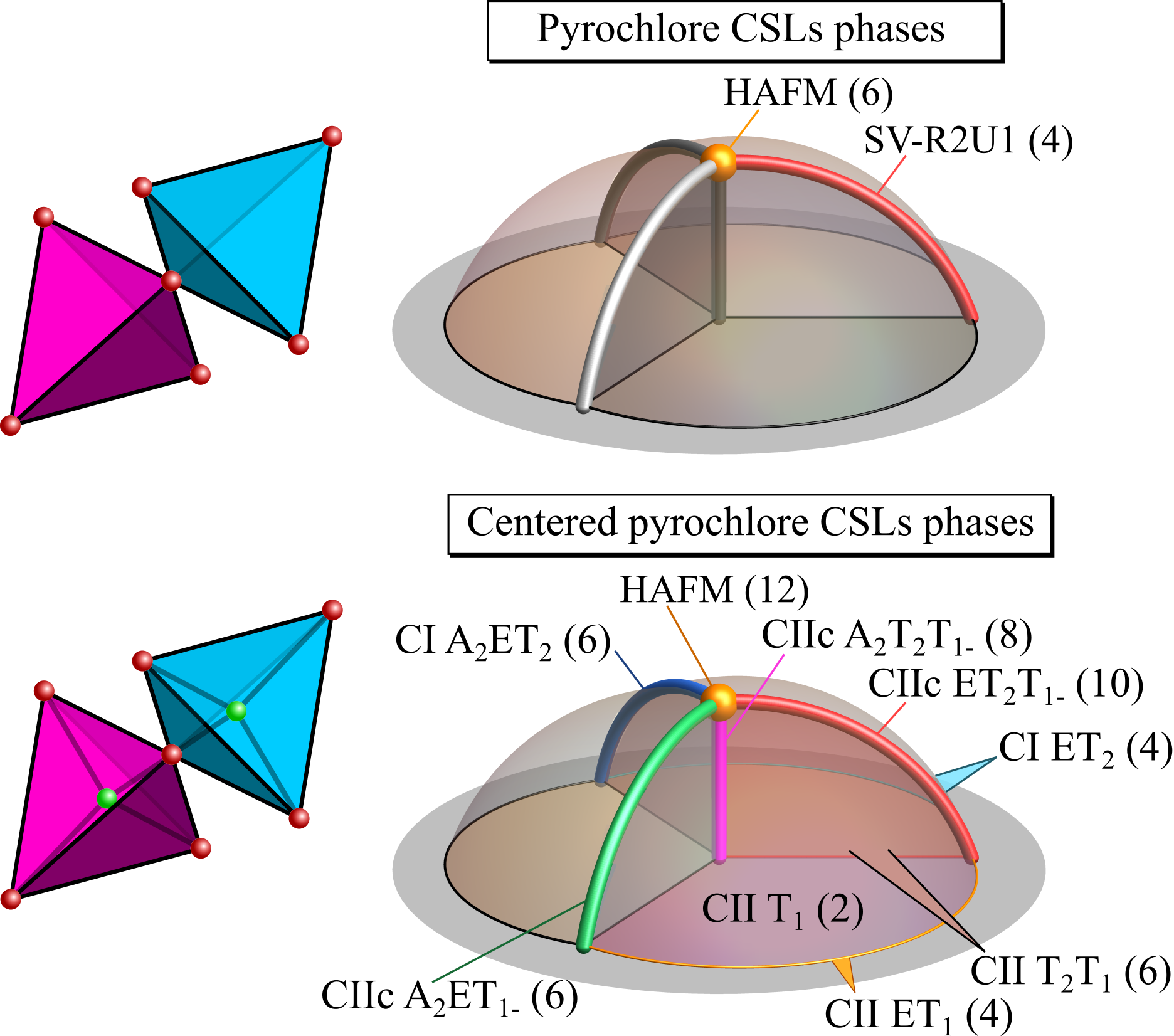
Our study reveals that, despite its close relation to the pyrochlore lattice, the addition of a central site has profound consequences. First, the two additional degrees of freedom per unit cell introduce extra fluctuation channels, stabilizing a much broader variety of spin-liquid phases. Most of these phases exhibit multifold pinch points, associated with fractonic physics. Second, the distinct symmetry properties of the central sites allow them to behave differently from the pyrochlore sites. This leads to mixed phases in which one family of sites partially orders while the other realizes a classical spin liquid phase. It also enables a peculiar spin-liquid phase in which the structure factor of the pyrochlore sites displays pinch points, whereas the contribution from the central sites alone does not. This means that the spin degrees of freedom of the spin liquid phase splits into a Coulomb phase with a zero-divergence, and an exponentially decaying spin liquid with potential fragile topology.
Beyond these general results, this framework allows us to revisit the low-temperature phase realized in Mn(ta)$_2$ thanks to NMR and neutrons experiments, shining a new light on the phase realized by this material.
[1] R. P. Nutakki et al., Physical Review Research 5, L022018 (2023).
[2] R. P. Nutakki et al., SciPost Physics 15, 040 (2023).
[3] H. Yan et al., Physical Review B 95, 094422 (2017).
Contact : S. Capponi