Non-equilibrium dynamics of many-body systems has been for decades a widely open and unresolved problem of theoretical physics motivated by, and with applications to, a broad spectrum of subfields ranging from ultracold atoms to hot nuclear matter, from condensed matter to dense plasmas. Non-equilibrium and dissipative many-particle dynamics has a long history which can be traced all the way back to Bohr’s early pioneering work on charged-particle penetration and stopping in matter and later on nuclear collision dynamics. The nuclear physics domain has been largely explored over the last 3-4 decades in the case of heavy ions collisions leading to rich and complex patterns, which could be addressed at a high level of experimental detail but mostly with classical or semi-classical theories with some insights into approximate quantum treatments. Non-equilibrium dynamics has also become a key issue in transport processes in solid state physics, in ultracold bosons and fermions gases (“quenches”) and in the electronic dynamics in atoms, molecules driven by ultrashort and strong laser fields .
In a cluster/molecule irradiated by a strong laser the many-electron system initially in its ground state progressively absorbs energy and is thus driven into a highly excited state. Following ionization, further storage of energy is facilitated by the increased ionization potential of the ionized species. The progressively heated electron cloud will eventually couple to ionic degrees of freedom (electron-phonon coupling). By construction time dependent mean field approaches, even as the robust usual ones based on Time Dependent Density Functional Theory cannot access dissipation and thermalization. And because the (large) deposited excitation is partially evacuated by ionization the remaining system is both far off equilibrium and still fully quantum which makes semi-classical approximations only marginaly valid, except in some cases for very large systems and high excitation energies. This leaves a large open gap between low and high energies covering many laser irradiation scenarios, in particular the moderate excitation energies where quantum effects remain dominant (deposited energy a few times the first ionization potential). The latter scenarios, because of duration and energy deposition lead to dissipative effects and thermalization of the electron cloud, which cannot be accessed in practice by standard mean field approaches. Classical and semiclassical approaches, in turn, live from such dissipative features but overlook decisive quantum effects, as observed in PES.
As the external electromagnetic field drives the system into an excited state, the non-linear response of the system comprises a rapidly varying superposition of many excited N-electron states. This suggests that the approximation in terms of an incoherent mixture of multiply excited states may capture essential features of many-body correlations at later stages once sufficient amount of energy has been deposited. The QDD package, by construction, fulfils this intermediate energy gap.
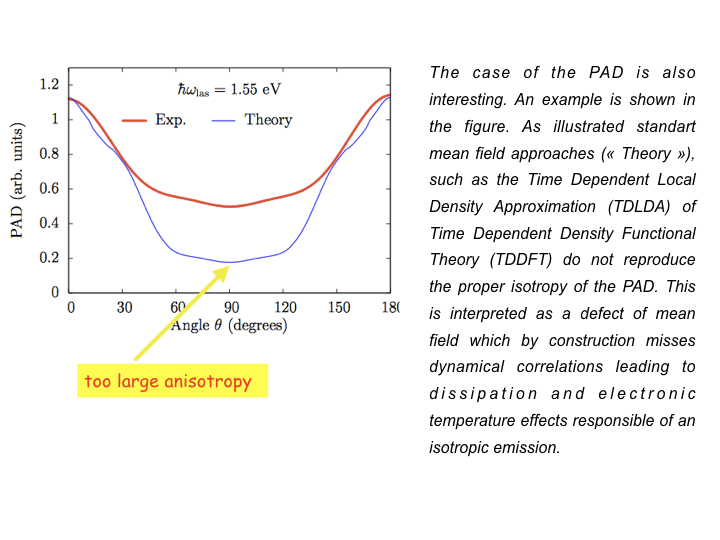
Ionization properties can be attained by the Velocity Map Imaging (VMI) technique which provides a double differential cross section (energy and angular resolved) of ionization. Energy integration provides the Photo Angular Distribution (single differential, angular resolved, PAD). One expects PAD to have a U shape with more ionization along laser polarisation axis. The transverse PAD component reflects the degree of isotropy of the PAD, itself directly linked to the possible thermalization of the system. Angular integration provides the Photo Electron Spectrum (single differential, energy resolved cross section, PES). At high excitation PES has a close to exponential shape which can be characterized by an effective temperature, itself again partly reflecting the degree of thermalization of the system.
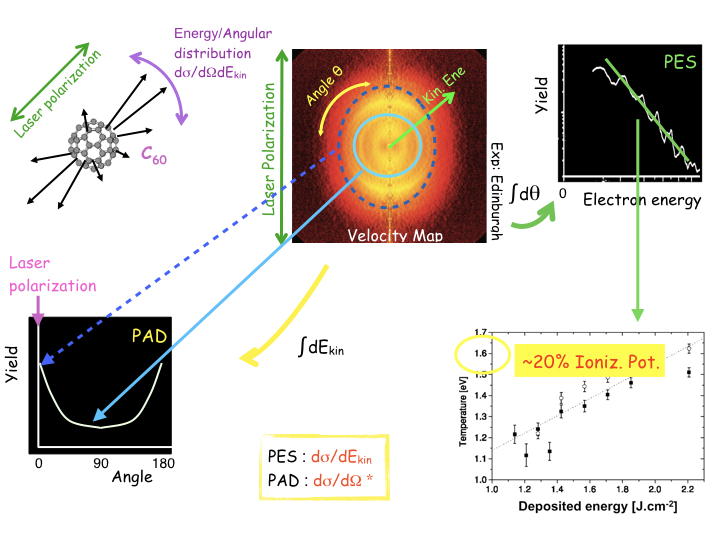
Many experiments have been done in C60. The example shows a systematics of effective PES temperatures as a function of laser fluence. The important point here is that these temperatures can reach large values, corresponding to a sizable fraction of the Ionization Potential (IP) of the system. This is interpreted as reflecting a large electronic temperature.