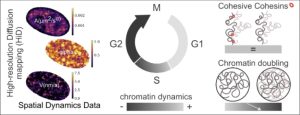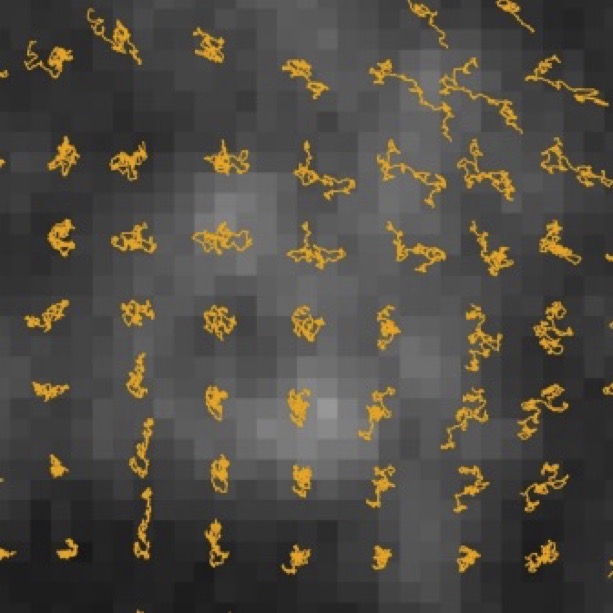
In the nucleus, chromatin —composed of DNA and proteins— is in constant motion. Using a new microscopy technique and physical simulations, members of the group PhyStatMath in collaboration with K. Bystricky’s team have shown that these movements slow down when human cells replicate their genome. Published in Nucleic Acids Research, this research suggests that this slowdown results from an increase in the amount of chromatin in the nucleus.
Observing chromatin in motion — In the cell nucleus, DNA is associated with proteins to form chromatin. Chromatin is organized into domains whose arrangement contributes to the proper regulation of genes. But this organization is not static: chromatin is constantly moving under the combined influence of thermal motion—which induces diffusive movement—and various cellular processes.
To study these movements, researchers developed a video microscopy method capable of capturing an image every 200 milliseconds. In living human cells, chromatin is made fluorescent to track the trajectories of thousands of its segments within the nucleus. They then compared these trajectories to physical models in which the chromatin fiber is treated as a long polymer—that is, a chain consisting of a succession of units called nucleosomes. This method, called High-resolution Diffusion Mapping (Hi-D), makes it possible to map the physical parameters that characterize chromatin movements and to compare the effects of different biological processes.
A slowdown during genome replication — Scientists have been studying chromatin movements during the cell cycle—the sequence of stages leading to cell division. This cycle includes a growth phase, called G1, followed by an S phase during which DNA is replicated, and a second growth phase, G2, which precedes cell division. Using fluorescent markers to identify these stages, the team demonstrated that chromatin movements slow down when cells enter the S phase and begin to replicate their genomes.
A consequence of nuclear crowding? — To understand this slowdown, the authors examined two phenomena associated with DNA replication. The first involves cohesins, ring-shaped proteins that hold together the copies of chromatin produced during replication. These bonds are essential for the proper distribution of genetic material between the two daughter cells at the time of division.
However, experiments conducted in a cellular model that allows for the removal of cohesins show that the slowing of chromatin movements does not depend on their presence. Simulations confirm that the number of bonds formed by these proteins is insufficient to significantly alter these movements.
The second hypothesis concerns the increase in the amount of chromatin in the nucleus during replication. To study this, researchers simulated the behavior of a long polymer confined within an increasingly smaller sphere. Its diffusive movements gradually slow down as the available space decreases. The parameters obtained are comparable to those measured by microscopy in living cells during the cell cycle.
These results suggest that the increasing crowding within the nucleus during genome duplication contributes to the slowing down of chromatin. By providing insight into the movements of the genome in living cells, the Hi-D method thus opens up new avenues for understanding the functioning and organization of the nucleus.
Référence : Martin Rey-Millet, Léa Costes, Erwan Le Floch, Habib Ayoub, Quentin Saccomani, Manoel Manghi, Kerstin Bystricky, Cell cycle-dependent chromatin motion: a role for DNA content doubling over cohesion, Nucleic Acids Research, 54 (18), gkag951 (2026)