
QDD is the acronym for Quantum Dissipative Dynamics, a set of theories developed to account for incoherent dynamical correlations in clusters and molecules. Dynamical correlations are correlations beyond mean field dynamics. Incoherent ones become dominant in far off equilibrium situations attained for large excitation energies and are responsible for dissipative behaviors.
QDD provides three levels of refinement starting from the full Stochastic Time-Dependent Local Density Approximation (STDLDA) which treats dynamics with an ensemble of mean field trajectories and which integrates both dissipation and associated mean field fluctuations. This allows to address a wide range of dynamical scenarios even including bifurcations such as in dissociative dynamics. STDLDA amounts to solve a quantum stochastic kinetic equation in which the quantum Boltzmann equation is complemented by a stochastic collision term, delivering a so called Boltzmann Langevin equation. The next lower level of theory is Average STDLDA (ASTDLDA) in which mean field fluctuations are canceled out. This simplified version of ASTDLDA is computationally more powerful than STDLDA and allows to explore dynamical scenarios at lower excitation energies. ASTDLDA amounts to solve a quantum Boltzmann equation as the stochastic collision term then averages out to zero. Finally the lowest level of theory is provided by a Relaxation Time Ansatz (RTA) approximation of the collision term. The hierarchy between these three approaches is schematically given below.
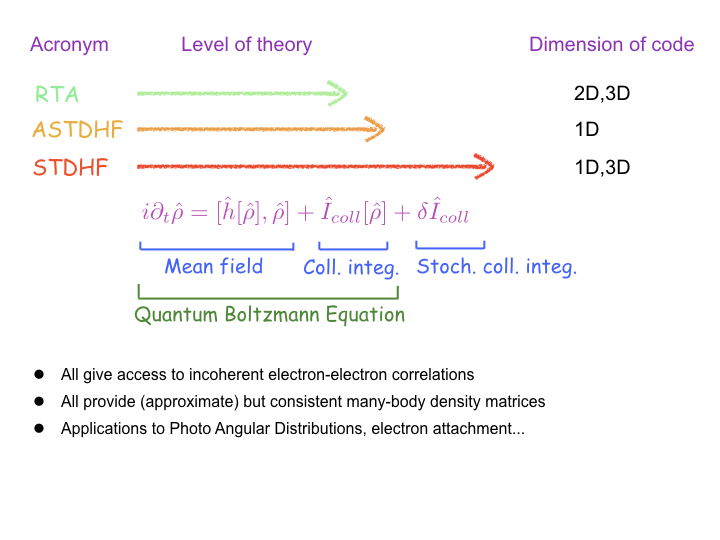
The aim of this page is to provide a brief presentation of QDD theories and an open access to our codes.
- Scientific Context
- Some related papers
- History of the QDD code package
- The QDD source code is available from our GIT server at (presently with ID and password): https://git.irsamc.ups-tlse.fr/user/sign_up
- Tutorial on QDD: contents of the tutorial and archive containing the input files and some output files of the activities of the tutorial.