Toulouse, Nov 25-27 2026
Organizers : P. M. Dinh, N. Maitra and E. Suraud
Aim and objectives
Following the tradition of the previous successful meetings that have started in 2009, the Theory Days workshop aims at stimulating constructive discussions, collaborations, and knowledge exchange among a selected group of theoreticians. The edition of this year will be dedicated to « Dynamics of symmetry breaking ».
Symmetry breaking is the collapse of a symmetric system into a less symmetric state. Examples are numerous in physics and chemistry. Symmetry breaking may occur during the dynamics of an initially symmetric system. It may then lead to counterintuitive behaviors. Generally speaking, mean-field is well known to potentially drive symmetry breaking. This reflects its usually incomplete quantum nature, for example, in relation to the loss of linearity of governing equations leading to the loss of superposition features. Conversely, mean-field overlooks dynamical scenarios involving bifurcations, which require treatments beyond an average one.
The massive use of mean-field theories in nuclear physics, confronted with the many underlying symmetries characterizing nuclei, provide typical examples of situations in which symmetry breaking has been identified and widely analyzed for years. Some of them will be further discussed during the workshop. The case of condensed matter physics will also be examined with the same bias towards symmetry breaking situations. Density Functional Theory (DFT), as a workhorse of electronic physics, will be discussed in some detail, as DFT mostly provides an effective mean-field description of atomic and molecular systems, as well as solids. It thus faces symmetry breaking situations with various degrees of relevance. For example, the case of molecular dissociation is emblematic of the limitations of the simple and widely used Local Density Approximation and most of its extensions. Conversely, recent investigations point out the dynamical symmetry breaking of initially perfectly symmetric states.
The aim of the workshop is to discuss the state of the art of some of these symmetry breaking in many situations, in particular the ones in which effective mean-field approaches miss it and the ones in which they spuriously create it.
Recent developments will be particularly addressed, in particular to the extent that increasing computational power allows more and more ambitious and realistic complete treatments of dynamics.
We plan to gather people from various groups working in this domain, mostly in western Europe. The workshop is intended to be a working forum, thus rather informal. The format will consist of a series of long, detailed talks, typically 1 hour (40 mn talk + 10 mn for questions), focusing in particular on ongoing problems and open issues. We thus urge participants to prepare their talks in this spirit. Ultimately a most efficient organization would consist of having a limited number of talks per representative group to avoid doublings.
Scientific program
The meeting will take place from Wed Nov 25th 2pm to Friday Nov 27th noon. It will be a hybrid event. Visioconference links will provided below soon.
Wednesday Nov 25th 2026
- 1:30pm-2:30pm: Chen Li, Theoretical Chemistry, College of Chemistry and Molecular Engineering, Pekin University, China (by visioconference)
- Title: Density functional approximations in the semiclassical limit: strong correlation error and symmetry breaking solutions
- visio link
- 2:30pm-3:30pm: Paul-Gerhard Reinhard, Institute for Theoretical Physics, University Erlangen, Germany (by visioconference)
- Title: TBA
- visio link
- 3:30pm-4:30pm: Filipp Furche,Department of Chemistry, University of California, Irvine, USA (by visioconference)
- Title: Making Sense of 𝒞𝒯 Symmetry Breaking in Time-Dependent Electronic Structure
- visio link
Thursday Nov 26th 2026
- 9am-10am: Roberta Leonetti, Institut de Chimie Théorique, Université Paris Saclay, Orsay, France
- Title: TBA
- visio link
- 10am-11am: Karim Bennaceur, Institut des 2 Infinis de Lyon, France
- Title: TBA
- visio link
- 11am-12am: Nicolas Tancogne-Dejean, Faculty of Physics and Astronomy, Ruhr Universität, Bochum, Germany
- Title: TBA
- visio link
- 2pm-3pm: Pierre Pujol, Laboratoire de Physique Théorique de Toulouse, France
- Title: Symmetry: to break or not to break
- visio link
- 3pm-4pm: Arjan Berger, Laboratoire de Chimie et de Physique Quantiques, Toulouse, France
- Title: Avoiding symmetry breaking and unphysical spectral properties in many-body electronic-structure theory
- visio link
- 4pm-5pm: Jordan Héraud, Laboratoire de Physique Théorique de Toulouse, Fédération de Recherche Matière et Interactions, Toulouse, France
- Title: TBA
- visio link
Friday Nov 27th 2026
- 9am-10am: Guillaume Scamps, Laboratoire des 2 Infinis de Toulouse, France
- Title: TBA
- visio link
- 10am-11am: Mickael Hubert, Ecole pour l’informatique et les techniques avancées, Toulouse, France
- Title: Probing New Physics with Atoms and Molecules: From CP Violation to Electric Dipole Moments
- visio link
- 11am-12am: Neepa Maitra, Department of Physics, Rutgers University, Newark, USA
- Title: TBA
- visio link
Access to Toulouse
Airports
Toulouse airport is connected to major West European airports and hubs (Paris Orly and Roissy Charles de Gaulle, Munich, Frankfurt, London, Amsterdam) with regular connections by Air France/KLM, Lufthansa, British Airways for the major companies and also with connections by (Low Cost) Easy Jet. Plane provides by far the simplest access to Toulouse with reasonable fees for sufficiently early booking.
There is a shuttle to downtown (first stop at Compans Caffarelli, on line B of metro) every 20 mn (cost is 8 euros for a one-way combined shuttle/metro ticket, no special fare for a return trip). As soon as one catches the shuttle, it takes about half an hour to get to the University, thanks to the connection with line B at Compans Caffarelli station (direction « Ramonville-Saint-Agne », get off at station Université Paul Sabatier).
Train
Central station is Toulouse Matabiau connected to line A of the metro and is connected to major French cities. To go to the university, take metro line A towards Basso Cambo, get off at Jean Jaurès (1 stop from Marengo-SNCF station), change to metro line B towards Ramonville-Saint-Agne and get off at Université Paul Sabatier. It takes about 20-25 minutes.
Directions to the meeting venue
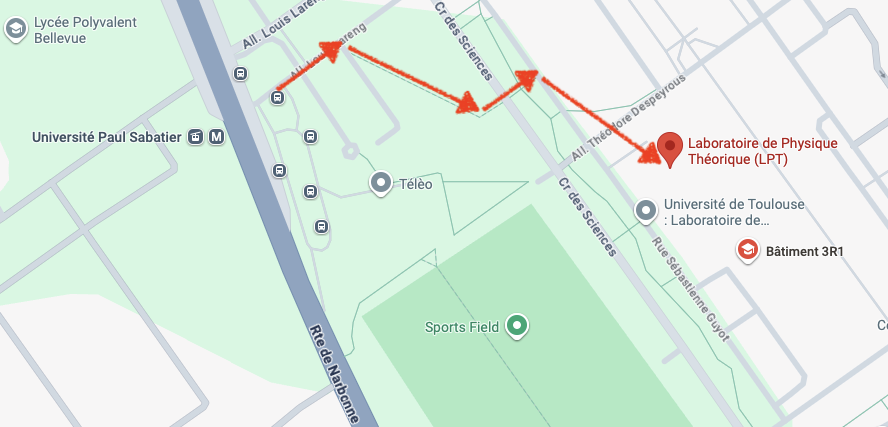
The meeting will take place in the seminar room of the 3R1 building, third floor, in the Laboratoire de Physique Théorique de Toulouse.
To reach the venue, follow the instructions below :
- Take metro line B, direction Ramonville Saint-Agne
- Get off at « Université Paul Sabatier »
- Exit towards the university
- Follow the indications of the map below.