Derviş Can Vural (University of Notre Dame)
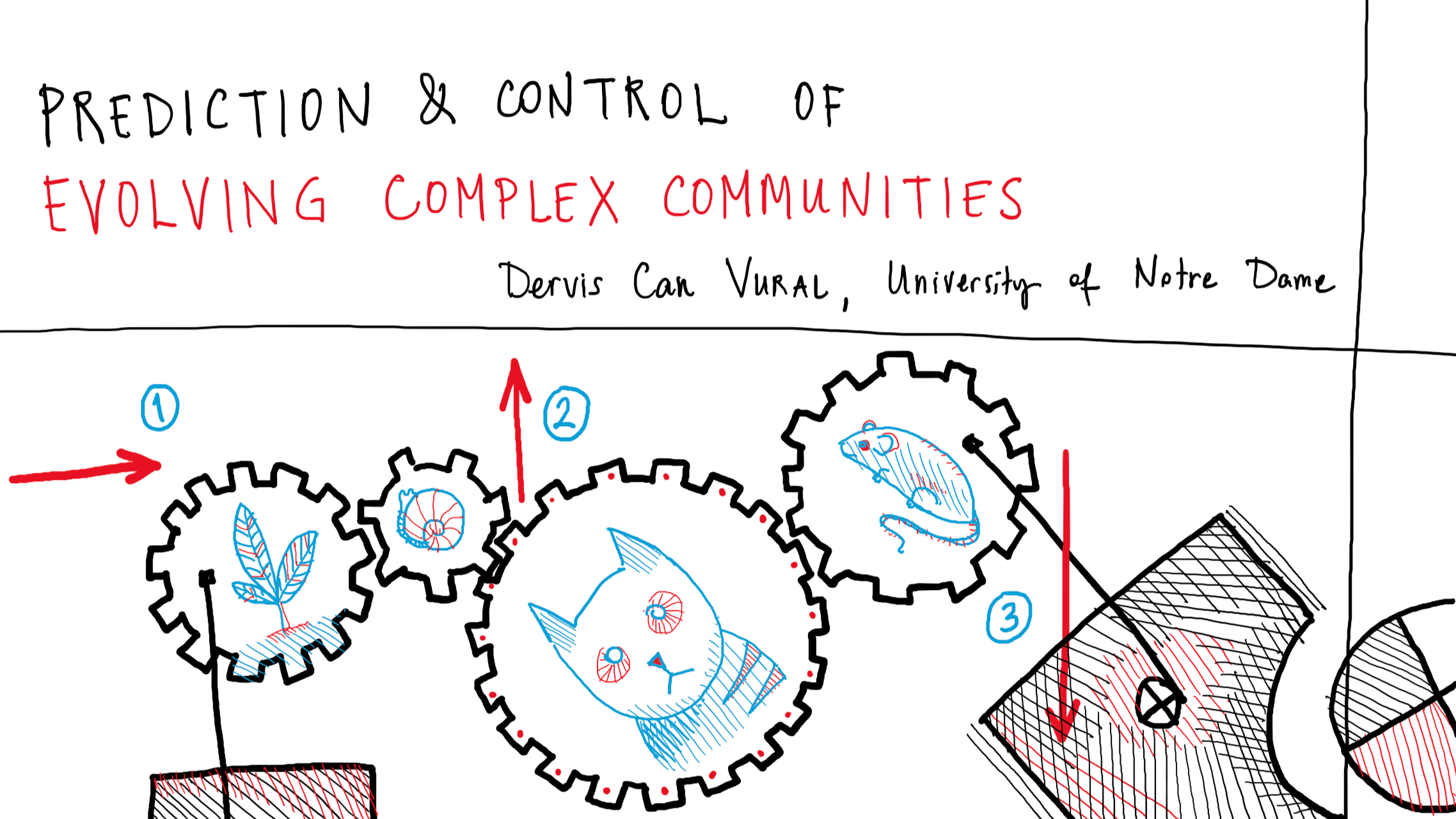
The interactions between species in a complex ecological community can be described in terms of simple reaction kinetics: Just like an enzyme turns a substrate into a product, a goat transforms plant mass into goat mass. However, unlike ordinary chemical reactions, the stoichiometry and reaction rates between species can change over time. In this talk I will present the mathematical description of three interesting cases where this happens [1-4]. (1) Evolution: Species adapt to each other: for example, some plants will evolve to become bitter or poisonous, in which case a goat may not carry out its transformation as effectively. In turn, the goat may evolve in response to this change, say, producing enzymes that will neutralize the poison. This “evolutionary arms race” will often finalize with an extinction (2) Migration: In some other cases, one or more new species might migrate and invade a community, thereby transforming the reaction network. This could happen naturally, through unintentional human activities, or intentionally, via ecological engineering. (3) Fluctuations: The mass transfer stoichiometry between species are often modulated by external factors such as sunlight, pH, and temperature: For example, in a cold year, a goat has to eat more plant mass before producing a new goat, since it must spend some of the energy to produce heat. In all three cases, I will focus on the statistics of species abundances, and the “first passage statistics” to extinction or some other biologically relevant target.
[1] V. Nguyen, D.C. Vural, Extinction in complex communities as driven by adaptive dynamics. Journal of Evolutionary Biology, January 1 (2021)
[2] V. Nguyen, D.C. Vural, Theoretical guidelines for editing ecological communities. Journal of Theoretical Biology, 534, 110945 (2021)
[3] M. Heidelman, D.C. Vural, Coexistence, crossover and extirpation in coalescent communities and ecotones, Oikos, e11952 (2026 )
[4] Eskin C, Nguyen V, Vural DC. Feasibility as a moving target: Fluctuating species interactions lead to universal power law in equilibrium abundances. arXiv preprint arXiv:2602.18942. 2026 Feb 21.
Short Resume: Derviş Can Vural completed his undergraduate in Middle East Technical University, Ankara. He then studied in theoretical condensed matter physics (with 2003 Nobel Lauriate Anthony J. Leggett), at University of Illinois at Urbana-Champaign, where he focused on the low temperature universal properties of disordered materials. After graduating, his interest shifted from populations of molecules to populations of organisms. He was a postdoctoral fellow at Harvard University, Applied Math Department, studying biological aging. Following that, he did another postdoc at Yale University, Department of Molecular Cellular and Developmental Biology, studying cooperative motion of bacterial swarms. Since 2014, he continues to be a professor of physics at University of Notre Dame, working on a diverse range of problems ranging from foundations of statistical mechanics and physics of information, to the complex community dynamics and biological evolution of ecosystems.
Contact: C. Sire